

Fiat Ducato 2026: Diesel vs Electric (E‑Ducato) Which One Fits Your Work?
TL;DR: The Fiat Ducato 2026 is one of the rare large vans that still gives you a clear choice: proven Euro 6E diesel for heavy loads and long days, or the new-generation E‑Ducato for quiet, city-friendly driving and dramatically lower day-to-day energy costs. If your routes are predictable and you can charge reliably, electric is now genuinely viable. If you haul heavy materials, drive far, or need maximum flexibility, diesel still wins on pure “no-surprises” usability.

Two Ducatos, Two Philosophies (and That’s the Point)
Buying a work van is not about hype it’s about matching the tool to the job. With the Ducato, Fiat Professional basically offers two different strategies under the same nameplate:
- Diesel Ducato: built for endurance, fast refueling, long distance, and higher payload ceilings.
- E‑Ducato (electric): built for urban access, smoother stop-and-go driving, and lower running costs now with a battery big enough to make “range anxiety” a planning problem instead of a deal-breaker.
Diesel Ducato 2026: Why It’s Still the Safe Business Choice
Despite tightening emissions rules across Europe, Fiat’s diesel strategy remains simple: keep the lineup broad and practical. In many markets the Ducato diesel range is offered around three main power steps 120 hp, 140 hp, and 180 hp with the latest-generation MultiJet diesel engines designed to meet strict regulations (Euro 6E in many EU listings).
Transmission: Manual for simplicity, 8‑speed auto for productivity
Most Ducato diesel variants still focus on the essentials: a 6‑speed manual for cost control and durability. But for drivers who live in traffic deliveries, trades, service calls Fiat also pairs an 8‑speed automatic with higher-output versions (commonly the 140 hp and 180 hp variants).
Real-world value of the automatic gearbox: It’s not just comfort. In stop-start routes, an auto can reduce driver fatigue, make the van easier for multi-driver fleets, and help maintain consistent driving style (which often improves consumption and reduces wear).
Torque matters more than horsepower in a loaded van
For commercial use, torque is the “get moving” number especially when you’re loaded, climbing ramps, or pulling away from junctions. Fiat has emphasized very high peak torque figures on top diesel specs (often cited up to 450 Nm on the strongest setups). That’s exactly what makes a large van feel confident when it’s working hard.
Efficiency updates: small percentages, big fleet money
Efficiency gains can sound boring until you multiply them by mileage and number of vehicles. Fiat has communicated aerodynamic and efficiency improvements that reduce fuel use versus earlier versions. Even a modest 5% reduction is meaningful in business math.
Example (simple): If a diesel Ducato averages 9.0 L/100 km, a 5% reduction is 0.45 L/100 km. Over 10,000 km that’s about 45 liters saved. Scale that across 5–20 vans, and it stops being pocket change.
E‑Ducato 2026: Electric Range Is Finally "Workable," Not Wishful
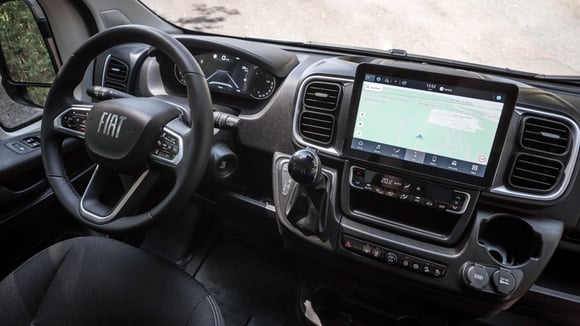
The new-generation E‑Ducato is the reason this diesel-vs-electric debate is now worth having. The headline upgrade is the battery: 110 kWh, enabling an official WLTP combined range around 424 km depending on configuration and market claims.
Reality check: plan for 300–350 km on demanding days
WLTP is a lab-style standard. In the real world full load, highway speed, cold weather, HVAC running most operators should plan more conservatively. A practical working assumption many fleets use is roughly 300–350 km on tougher days, then treat anything above that as bonus range.
Charging: the “lunch break top-up” becomes realistic
Fast charging matters more than maximum range for many urban operators. Fiat highlights that the E‑Ducato can go from 20% to 80% in about 55 minutes on a suitable DC fast charger. In operational terms, that means a long break can genuinely reset your afternoon route if the charger is available and reliable.
Diesel vs Electric: The Quick Comparison (Fiat Ducato 2026)
| Decision factor | Ducato Diesel | E‑Ducato Electric |
|---|---|---|
| Best for | Long distance, unpredictable routes, heavy trades, rural work | City/regional delivery, fixed routes, urban contractors, low-emission access |
| Payload (typical headline) | Up to ~2.0 t (varies by spec) | Up to ~1.5 t (battery weight reduces payload) |
| Energy / refuel time | Minutes at any fuel station | Fast charging possible; ~55 min (20–80%) on DC (conditions apply) |
| Daily operating cost (illustrative) | Higher (diesel + AdBlue, depending on fuel prices) | Often much lower per 100 km (electricity price dependent) |
| Driving feel | Strong, familiar, best for continuous mileage | Instant torque, quieter, smoother in stop-start traffic |
| Urban restrictions | Increasingly limited in some cities/LEZ rules | Typically favored for city-center access and noise-sensitive delivery |
The “Performance Match” Explained: Each Wins on Different Terrain
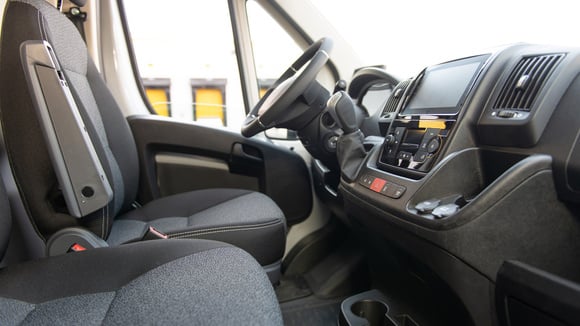
Diesel wins on payload and flexibility. The battery mass in an electric van is physics you can’t negotiate with. If your business routinely carries heavy materials (construction supplies, dense tools, bulk loads), that extra ~500 kg of payload headroom can decide whether you need a second trip every day.
Electric wins in urban productivity. Instant electric torque makes merging, short bursts, and stop-start driving feel effortless. It’s also quieter useful for early deliveries in residential areas and it’s often the simplest way to future-proof against tightening city regulations.
Cost of Use: Where the E‑Ducato Can Flip the Business Case
Many operators see the biggest difference not in performance, but in the spreadsheet. A common rule of thumb: electric energy per 100 km can cost far less than diesel sometimes by multiples depending on your electricity tariff and how often you can charge off-peak or at a depot.
Practical takeaway: The E‑Ducato’s economics get better when you control charging (depot/home base), have predictable mileage, and keep the van working in the city where regen braking and lower speeds help efficiency.
However, purchase price still matters. Fiat has publicly communicated pricing actions in the E‑Ducato program (including a widely cited “price reduction” narrative tied to the new generation). Even so, the smart move is to compare total cost of ownership (TCO) over 3–5 years: energy + maintenance + downtime + financing + resale.
Key Takeaways (Decision Checklist)
- Pick diesel if you need maximum payload, frequent long trips, or you can’t guarantee charging access.
- Pick E‑Ducato if your routes are predictable, mostly urban, and you can charge reliably (especially at a depot).
- Don’t guess your range: track your last 2–4 weeks of routes and build the decision around that data.
- Consider a mixed fleet: many businesses will get the best ROI by assigning electric vans to city routes and diesel vans to heavy/long jobs.
A quick Fiat context (internal reading)
If you’re also watching Fiat’s broader powertrain strategy beyond vans, this internal read is a helpful reference: Fiat 500 Hybrid 2026 review.
Fiat Ducato 2026 FAQ
Is the Fiat Ducato 2026 available as both diesel and electric?
Yes. The Fiat Ducato 2026 lineup continues with modern diesel options and the fully electric E‑Ducato variant, so buyers can match the powertrain to their routes and payload needs.
What’s the real-world range of the E‑Ducato in 2026?
Official WLTP figures can be around the low-400 km range for the newest battery setup, but many real work days (load, speed, temperature, HVAC) are better planned around roughly 300–350 km, then adjusted using your actual duty cycle.
How fast can the Fiat Ducato 2026 E‑Ducato charge?
On compatible DC fast chargers, Fiat commonly communicates about 55 minutes from 20% to 80%. Real times depend on charger power, battery temperature, and how busy the station is.
Which has the better payload: diesel Ducato 2026 or E‑Ducato?
Diesel usually wins. A typical headline comparison is roughly up to 2.0 t for diesel versus about up to 1.5 t for electric, because the battery reduces the available payload.
Is the Fiat Ducato 2026 diesel still worth it with emissions rules tightening?
For many businesses, yes especially if you operate outside restricted urban cores, carry heavy loads, or drive unpredictable long routes. Electric is getting better fast, but diesel remains the most universally flexible option today.
3 AI Image Prompts (for your blog visuals)
- Hero image: "A modern Fiat Ducato 2026 panel van parked in a European city street at sunrise, half the scene showing a diesel fueling station and half showing an EV fast charger, realistic photography, high detail, wide angle."
- Business use case: "Electric Fiat E‑Ducato delivering parcels in a dense urban area, quiet early-morning atmosphere, subtle motion blur, realistic commercial photography style, natural lighting."
- Worksite payload theme: "Diesel Fiat Ducato loaded with construction tools and materials at a worksite, rear doors open, visible cargo organization, realistic documentary photo, sharp detail."
Call to Action
Ready to choose your Fiat Ducato 2026?
- Build two quotes: diesel (140/180) and E‑Ducato (110 kWh).
- Compare them over 36–60 months using your real mileage.
- Do a test route: one “worst day" (heavy load + HVAC) and one “typical day."
Publishers: Add your contact button here (quote request / test drive booking / fleet consultation) and pin this article as your “Diesel vs Electric” cornerstone page.
External attribution (recommended): Data points referenced from Fiat Professional / Stellantis communications and automotive reporting. See sources below.


