

The premium three-row SUV class has rarely been this crowded or this expensive. Yet hiding in plain sight is a Japanese contender that delivers a genuine inline-six, rear-wheel-drive manners, and real luxury for tens of thousands less than the German establishment. The 2026 Mazda CX-90 isn't just a value play; it's a credible BMW X5 rival for roughly $25,000 less. Here's why so many luxury shoppers still misjudge it.
Key Takeaways
- The 2026 Mazda CX-90 uses an in-house turbocharged inline-six and a rear-wheel-drive-based platform — the same recipe as the BMW X5, Audi Q7 and Mercedes GLE.
- Pricing starts at $39,300 (plus $1,530 destination), undercutting a comparable BMW X5 by more than $31,000.
- It offers a genuinely adult-usable third row bigger than the Q7, XC90 and the discontinued X5 jump seats.
- Interior materials include Nappa leather, real maple wood, and Kakenui hanging stitching, plus physical controls buyers now crave.
- The main hesitations are badge prestige and an unproven long-term reliability record on a powertrain that's only ~3 years old.
A Premium Three-Row Segment That Keeps Getting More Crowded
Not long ago, European luxury three-row SUVs were a short list. That changed once Mercedes-Benz and BMW finally answered the Audi Q7 and Volvo XC90 with the GLS and X7, instantly doubling the number of large premium options on the table.
At the same time, the smaller two-row Europeans kept growing. The X5 and GLE stretched far enough to squeeze in token third rows — though the current X5 has dropped its third row entirely. For 2026, Audi's even larger Q9 is on the way, with a Porsche derivative likely to follow.
And that's before you count the non-European wave: the Acura MDX, the strong-selling Lexus TX, the Cadillac Vistiq and Escalade IQ, the incoming Genesis GV90, the current GV80, and a fleet of body-on-frame premium haulers from America and Japan. The segment is, frankly, packed.
Most buyers here want the same things: space for people or cargo, real style, ample power, and every luxury feature imaginable. Mazda's bet is that it can deliver all of that for dramatically less than the priciest European badges — and use the CX-90 to push the brand into the premium territory it has openly been chasing.
For a fair fight, this comparison focuses on the smaller European three-rows — the Mercedes-Benz GLE, Audi Q7 and Volvo XC90 — plus the two-row BMW X5.
Mazda's Unexpected Play: An Inline-Six and Rear-Wheel-Drive Architecture

The defining traits of the most respected SUVs in this class — the X5, GLE and Q7 — are a six-cylinder engine and a rear-wheel-drive-based architecture. Because Mazda aimed squarely at the best, it made the enormous investment to engineer its own turbocharged inline-six and a rear-drive platform entirely in-house, with no outside parts-sharing.
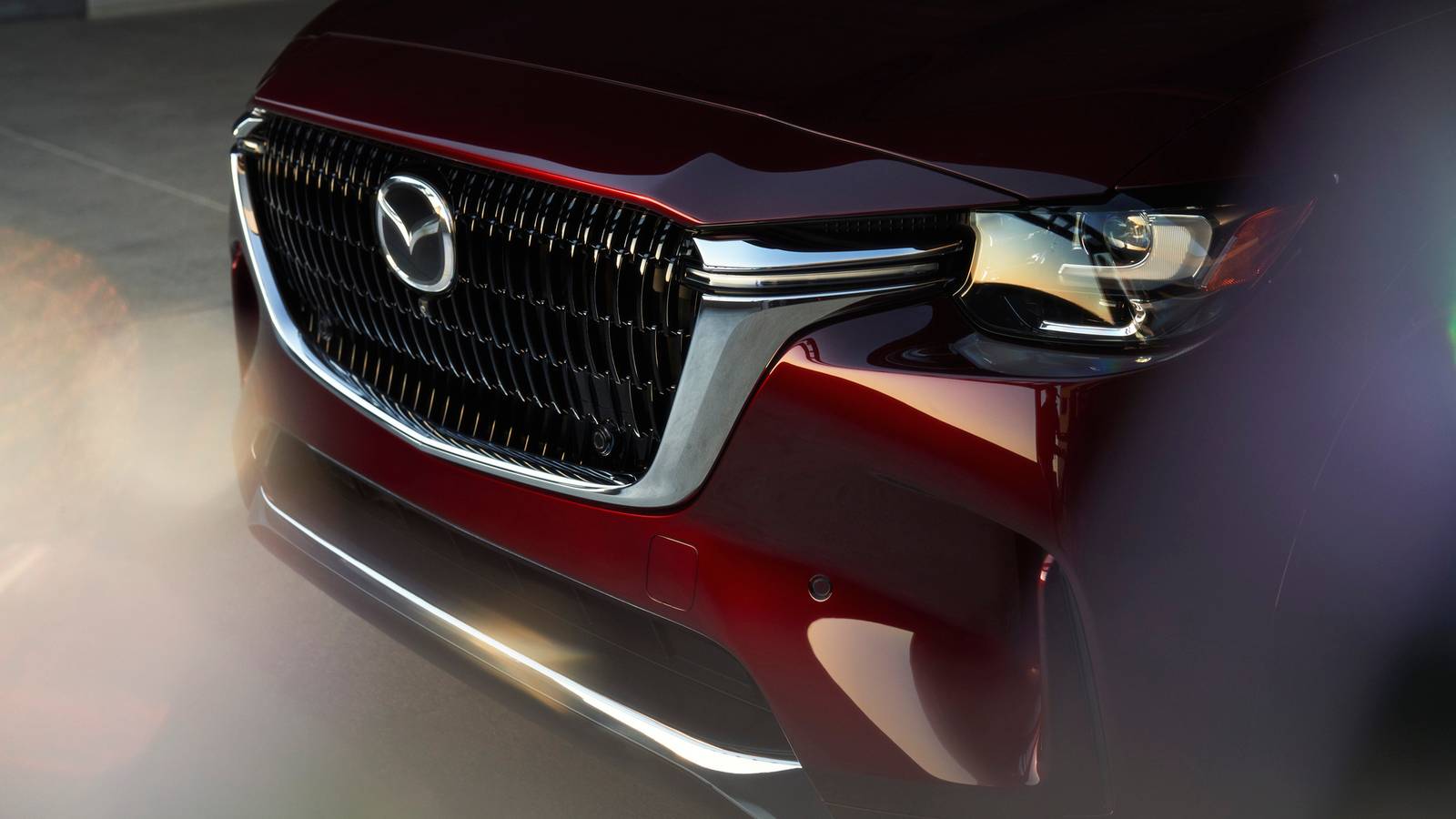
Outside of Genesis, no rival has committed this fully. Plenty offer six-cylinder options, but they ride on front-wheel-drive-based all-wheel-drive layouts. A welcome side effect of Mazda's approach is proportion: the long hood and set-back cabin give the CX-90 the stance of a proper premium SUV, and Mazda's designers used it to craft a look that's handsome without shouting — the kind of design that should age gracefully.
Power That Beats the Base Europeans
Mazda didn't just match the rivals; it often beat their entry engines on cylinder count and output. Only the X5 leads outright, with 375 horsepower against the 340 hp of the CX-90 Turbo S. Even so:
- The base CX-90 still makes 280 hp from a detuned version of the inline-six.
- Audi and Mercedes drop entry buyers down to 2.0-liter turbo four-cylinders, charging extra for their sixes.
- Volvo doesn't offer a six at all — its higher-output variant is a plug-in hybrid bolted to a turbo four.
- Mazda counters with a CX-90 PHEV too, though its 323 hp trails the Volvo XC90 T8's 455 hp.
Crucially, the inline-six isn't just adequate — it's smooth and torquey, very much in the European mold. On the road, the CX-90 isn't quite as sharp through corners or as eager to respond as an X5, but it otherwise compares well. Against the aging XC90 and Q7, it arguably feels better: more planted, more substantial, more confident — and reassuringly quiet, smooth and safe.
Surprisingly Luxurious Inside

If you've never sat in a CX-90 (or its two-row CX-70 twin), you might assume the trade-off for all that mechanical ambition is a budget-feeling cabin. It isn't. The interior is genuinely upscale — and it's aging like fine wine just as the industry tips into "screen burnout," with buyers increasingly rejecting giant tablet displays and the loss of tactile switchgear.
The CX-90 spares you that. Its screen is tastefully sized — large enough without dominating — and you can control it by touch or a rotary knob, exactly like a BMW X5. The digital gauge cluster sits in a hooded dash for a more traditional, driver-focused feel.
Material quality is a highlight:
- Available Nappa leather and genuine maple wood trim.
- A signature hanging stitch linking the upper and lower dash, inspired by the Japanese bookbinding technique Kakenui.
- Plush knee padding on the console and doors — a thoughtful touch some rivals skip.
The Europeans still win on a few details — slightly nicer buttons, available massaging seats, fancier audio and richer ambient lighting — but at their far higher prices, they should.
Space Where It Counts: A Third Row Adults Can Actually Use
The CX-90's trump card is room. It's over five inches longer than the X5, GLE and XC90; only the Q7 comes close, at 1.2 inches shorter. The payoff is a third row that genuinely works for adults — not the jump seats found in the GLE and discontinued X5, nor the kid-only benches in the Q7 and XC90. It's not the segment champion (the Lexus TX holds that title), but it comfortably out-rooms the Europeans, and even the longer GLS and X7 struggle to feel more spacious back there.
Fantastic Value — If You're Open-Minded

So the CX-90 matches its pricier rivals in nearly every meaningful way. The obvious question: how much do you actually save? A lot.
The 2026 Mazda CX-90 starts at $39,300 plus a $1,530 destination charge — and that base price already includes all-wheel drive, three-zone climate control, heated seats, and the full suite of safety tech.
Entry-Level Pricing, Like-for-Like
| Model (comparable equipment) | Base Price | Destination | vs. CX-90 |
|---|---|---|---|
| 2026 Mazda CX-90 | $39,300 | $1,530 | — |
| BMW X5 | $70,950 | $1,450 | +$31,000+ |
| Mercedes-Benz GLE | $68,600 | $1,350 | +$29,000 |
| Audi Q7 | $62,000 | $1,295 | +$23,000 |
| Volvo XC90 | $61,050 | $1,395 | +$22,000 |
Yes — a base BMW X5 now tops $70,000. The X5 does carry the most standard horsepower, so it's not a perfectly even match, but the gap is staggering nonetheless.
Loaded-Trim Pricing
At the top of the range the Europeans pack in more features, but the savings remain dramatic. A fully loaded CX-90 Turbo S rings up at a reasonable $57,570 plus $1,530 destination.
| Loaded model (comparable kit) | Price | Destination | vs. CX-90 Turbo S |
|---|---|---|---|
| CX-90 Turbo S (fully loaded) | $57,570 | $1,530 | — |
| BMW X5 (no third row available) | $82,150 | $1,450 | +$24,500 |
| Mercedes-Benz GLE 450 | $85,770 | $1,350 | +$28,000 |
| Audi Q7 (Nappa adds ~$4,800) | $78,700 | $1,295 | +$21,000 |
| Volvo XC90 (295 hp) | $73,850 | $1,395 | +$16,000 |
| Volvo XC90 T8 PHEV (455 hp) | $83,900 | $1,395 | +$26,000 |
Whichever way you slice it, the Mazda saves you the price of a well-equipped second car. If you'd like to dig deeper into how the big German players are evolving, see our prototype look at the 2027 BMW X5 Neue Klasse and the freshly revealed 2027 Audi Q7 and SQ7.
Pros
- In-house turbo inline-six + RWD platform
- Beats base European rivals on power
- Genuinely adult-friendly third row
- Upscale cabin with real wood and Nappa leather
- Keeps physical controls and a rotary knob
- Massive price advantage ($16k–$31k)
Cons
- Mazda badge lacks European prestige
- Unproven long-term powertrain record
- Not quite as agile as a BMW X5
- PHEV trails the Volvo XC90 T8 on power
- Fewer top-end frills (massage seats, etc.)
Watch: A Mechanic's In-Depth 2026 Mazda CX-90 Review
For a hands-on, under-the-hood verdict on the inline-six CX-90 — including the things worth knowing before you buy — this thorough walkthrough from a working mechanic is well worth the time:
Why Buyers Still Miss It
If the CX-90 largely matches the Europeans for tens of thousands less, why did it move "only" 55,156 units last year? That's a respectable figure, but a few hurdles keep some premium shoppers away.
1. Brand Bias and Bragging Rights
For buyers who take pride in their badge, "I drive a BMW (or Mercedes, or Audi)" simply impresses more people than "I drive a Mazda." Mazda has always built good cars, but its push toward premium positioning is recent — and perceptions take years to shift.
2. An Unproven Powertrain Record
The European sixes and transmissions are largely known quantities. The CX-90's bespoke inline-six has only been on sale for about three years, so its long-term track record is still being written. The encouraging news: it hasn't generated the kind of alarming headlines surrounding Toyota's newest six-cylinder, which suggests Mazda's engineering is solid. And for luxury buyers who tend to lease or trade frequently, an uneventful three years may be all that matters anyway.
Shopping the broader three-row field? It's worth cross-shopping family-focused alternatives like the 2026 Kia Sorento and the 2026 Hyundai Palisade Hybrid, or comparing luxury electrics in our Mercedes GLC EV vs. BMW iX3 showdown. Curious about powertrain choices in general? Our best hybrid vehicles guide breaks down the trade-offs.
Frequently Asked Questions
Is the 2026 Mazda CX-90 a real rival to the BMW X5?
Yes. The CX-90 uses an in-house turbocharged inline-six and a rear-wheel-drive-based platform — the same formula as the X5 — and matches it closely on luxury, refinement and space. The X5 is sharper to drive and more powerful in base form (375 hp vs. 340 hp for the CX-90 Turbo S), but the Mazda costs roughly $25,000–$31,000 less for comparable equipment.
How much does the 2026 Mazda CX-90 cost?
The 2026 CX-90 starts at $39,300 plus a $1,530 destination charge, with standard all-wheel drive, three-zone climate control, heated seats and full safety tech. A fully loaded CX-90 Turbo S runs about $57,570 plus destination.
Does the Mazda CX-90 have a usable third row for adults?
Yes. At over five inches longer than the X5, GLE and XC90, the CX-90 offers a third row that genuinely fits adults — better than the jump seats in the GLE and discontinued X5, and roomier than the kid-friendly benches in the Q7 and XC90. Only the Lexus TX offers more space in the unibody premium class.
What engines does the 2026 Mazda CX-90 offer?
The lineup centers on a turbocharged 3.3-liter inline-six: 280 hp in the base tune and up to 340 hp in the Turbo S. There's also a plug-in hybrid (CX-90 PHEV) producing 323 hp, which pairs a four-cylinder with an electric motor for short electric-only driving.
How does the CX-90 compare to the Audi Q7 and Volvo XC90?
The CX-90 generally feels more planted and modern than the aging Q7 and XC90, and it beats both on standard six-cylinder power (the Q7 starts with a turbo four; the Volvo offers no six at all). It also undercuts them by roughly $22,000–$23,000 at the entry level.
Is the Mazda CX-90 reliable?
Its bespoke inline-six has only been on sale for about three years, so the long-term record is still developing. So far it has avoided major reliability scandals, suggesting solid engineering — but it can't yet match the decades-long track record of the European sixes.
Is the Mazda CX-90 worth buying over a European luxury SUV?
For value-focused buyers who care more about power, comfort and space than badge prestige, yes. You sacrifice some brand cachet and a few top-end frills, but you save the equivalent of a second car. Shoppers who prioritize prestige or maximum driving sharpness may still prefer the X5.
The Bottom Line
The 2026 Mazda CX-90 is proof that premium doesn't have to mean European — or expensive. It delivers an authentic inline-six, rear-drive poise, a cabin trimmed in real wood and Nappa leather, and a third row that actually works, all while undercutting the BMW X5, Mercedes GLE, Audi Q7 and Volvo XC90 by tens of thousands of dollars. The only things it can't yet buy are a prestige badge and a decades-long reliability legend — and for many smart buyers, those are prices well worth not paying. If you can look past the logo, this is the value champion of the premium three-row SUV world.
Make the Smart Money Move
Found your next family SUV? Protect it for less. Compare top-rated providers in our latest guide and keep more cash in your pocket.
See the Best Car Insurance Companies of 2026 →Specifications, pricing and availability are based on manufacturer information at the time of writing and may vary by market and trim. Sources: Mazda, BMW, Mercedes-Benz, Audi, Volvo. Images: CarBuzz / Mazda.


