

Hyundai INSTER Electric (2025/2026): Range, Price, Specs & Verdict
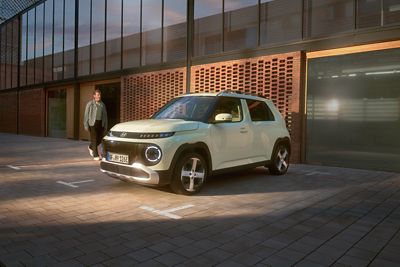
The Hyundai INSTER brings SUV attitude to the city-car segment. Image: Hyundai Media
The Hyundai INSTER electric is proof that a small EV can feel big on ideas. With a footprint barely larger than a typical city hatchback, it delivers a raised driving position, up to 370 km of WLTP range, and a cabin that flips between daily commute and weekend cargo hauler in seconds. Whether you are shopping for an affordable electric car, a second family runabout, or your first step into zero-emission driving, the INSTER demands attention.
Hyundai INSTER at a Glance
Video Review: Hyundai INSTER in the Real World
Before diving into the details, see how the INSTER performs in everyday traffic, charging, and on the highway in this independent video review.
Credit: Chris Vanderstock on YouTube
What Is the Hyundai INSTER?
Launched as Hyundai's smallest fully electric model, the Hyundai INSTER electric sits in the A-segment but borrows styling cues from larger SUVs. It is not a sedan pretending to be tough, nor a tall hatchback without purpose. It is a deliberately compact urban EV that maximizes every millimeter of its 3.825-meter length.
Think of it as the electric answer to buyers who want:
- Easy parking and tight turning circles for city streets
- Zero tailpipe emissions and low running costs
- Enough range for a week of commuting without charging
- Surprising interior flexibility for shopping, pets, or road trips
In Europe, the INSTER starts at roughly €25,350, with leasing offers from around €129 per month depending on local incentives and terms. In other markets, such as Australia, pricing begins near $39,000 AUD plus on-road costs for the Standard Range model, while the UK lists the car from about £23,495. Those figures make it one of the most accessible electric SUVs from a mainstream brand.
Design: Small in Size, Big in Personality
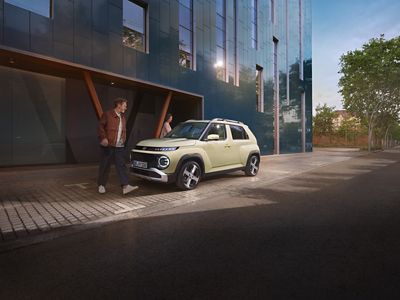
Hyundai did not play it safe with the INSTER's look. The front end carries a friendly but confident face, with circular LED pixel lighting and contrasting wheel-arch cladding that lifts the visual stance. The body sits higher than a typical city hatch, giving drivers the SUV-style visibility many buyers prefer.

The INSTER's circular pixel lights and raised stance give it unmistakable road presence.
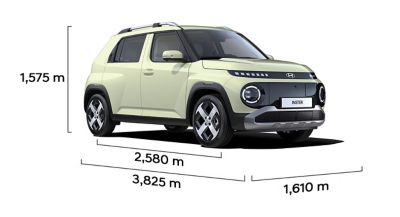
Key exterior dimensions include:
- Length: 3,825 mm
- Width: 1,610 mm
- Height: 1,575 mm
- Wheelbase: long for the segment, unlocking cabin space
Color choices include playful shades such as Buttercream Yellow Pearl, which has become a social-media favorite, alongside more traditional options. The design is clearly aimed at younger urban buyers and families looking for a second car that does not blend into the background.
Interior & Space: The INSTER's Party Trick
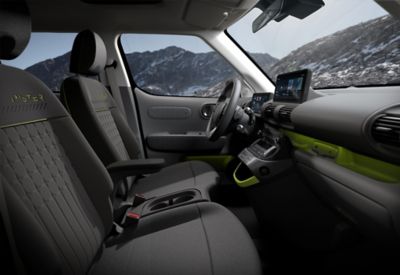
Where the INSTER really surprises is inside. Despite its tiny exterior, the cabin feels airy thanks to a tall roofline, flat floor, and seats that can be arranged in multiple ways.

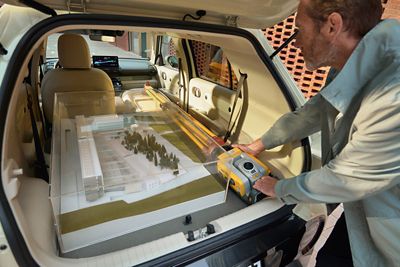
Fold-flat seats turn the INSTER into a surprisingly practical cargo carrier.
Highlights include:
- Rear seats slide 160 mm, letting you choose between legroom and luggage space
- Boot volume: 280 L as standard, expandable to 351 L with the bench forward, and 1,059 L with the rear seats folded flat
- Flat floor across the entire cabin for easier loading and foot space
- Front passenger seat folds flat to fit longer items such as skis or ladders
Depending on the market, the INSTER is offered as a four-seater or five-seater. The four-seat version fixes the rear bench, while the five-seat model adds the sliding function. Even adults around 180 cm can sit comfortably in the rear for city trips, although the cabin is narrow enough that shoulder room is best suited to two adults in the back.
Up front, dual 10.25-inch screens handle the digital instrument cluster and infotainment. The system supports over-the-air updates, wireless phone charging on higher trims, and a clear, responsive layout that avoids the menu-overload problem of some rivals.
Battery, Range & Performance
The Hyundai INSTER is offered with two battery choices, both lithium-ion and front-wheel drive:
| Model | Battery | Power | 0-100 km/h | WLTP Range | Urban Range |
|---|---|---|---|---|---|
| INSTER 42 kWh | 42 kWh | 97 hp / 71 kW | 11.7 s | 327 km | 473 km |
| INSTER 49 kWh | 49 kWh | 115 hp / 85 kW | 10.6 s | 370 km | 518 km |
| INSTER Cross 49 kWh | 49 kWh | 115 hp / 85 kW | 10.6 s | 359 km | 480 km |
Performance is not the point here. The electric motor delivers instant, quiet torque that makes the INSTER feel quick around town and perfectly adequate on the highway. Top speed is 140 km/h for the 42 kWh model and 150 km/h for the 49 kWh variants.
What matters more is efficiency. The 42 kWh model consumes as little as 14.3 kWh/100 km on the WLTP combined cycle, while the 49 kWh version sits around 14.9 kWh/100 km. A heat pump is fitted as standard, which helps preserve range in cold weather and is one of the features often missing on cheaper rivals.
Charging: Faster Than You Might Expect
One of the INSTER's strongest selling points is its charging speed. Many small EVs in this price bracket top out at 50 kW or less. The INSTER can charge at up to 85 kW on DC and, on a 120 kW or faster public charger, goes from 10 to 80 percent in about 30 minutes.
A 30-minute DC fast charge can restore enough range for days of urban driving.
Charging times at a glance:
- Domestic socket (2.8 kW): 17 to 19.5 hours
- AC wallbox (11 kW): 4 to 4 hours 45 minutes
- DC 50 kW (10-80%): 58 minutes
- DC 100 kW (10-80%): 39 minutes
- DC 120+ kW (10-80%): 30 minutes
The charging port accepts Type 2 for AC and CCS Combo for DC. Hyundai's Bluelink app allows pre-conditioning of the cabin and battery, which is especially useful in winter to speed up charging and preserve range.
Trims & Equipment
In most European markets, the standard INSTER is offered in three trim levels:
- INSTER: Keyless entry and start, rear parking sensors and camera, automatic climate control, autonomous emergency braking, electric folding mirrors, and a full European navigation system with over-the-air updates.
- Intuitive: Adds a front center armrest, front parking sensors, wireless phone charging, LED rear lights, 15-inch alloy wheels, and sliding rear seats.
- Creative: Adds customizable LED ambient lighting, LED interior and trunk lighting, bi-LED headlights, 17-inch alloy wheels, sequential front indicators, and a steering wheel with dynamic LED indicators.
Safety equipment is comprehensive for the class, including lane-keeping assistance, forward collision avoidance, and a rear-view camera. The INSTER has not yet been tested by Euro NCAP in many markets, but the safety suite is on par with larger Hyundai models.
Hyundai INSTER Cross: The Adventurous Sibling
For buyers who want a tougher look, the Hyundai INSTER Cross adds rugged body cladding, unique bumpers, a protective skid plate, and an exclusive matte Amazonas Green paint option. It is only available with the 49 kWh battery and can be fitted with a roof basket for extra carrying capacity.

The INSTER Cross swaps city chic for a more rugged, adventure-ready look.
The Cross is slightly taller and wider than the standard car, with a WLTP range of 359 km. It comes in Creative and Executive trims. The Executive adds a sunroof, heated front seats, a heated steering wheel, and an additional safety pack. While it is not a true off-roader, the raised stance and body protection make it ideal for light trails, gravel roads, and active lifestyles.
Ride, Handling & Everyday Usability
On the road, the INSTER feels more refined than its size suggests. The suspension copes well with city potholes, and the electric powertrain is whisper-quiet at low speeds. The steering wheel and column stalks are borrowed from larger Hyundai models, which gives the interior a more premium feel than the price implies.
Regenerative braking can be adjusted via paddles behind the steering wheel, letting drivers choose between one-pedal-style driving and a more coasting feel. The turning circle is tight, and the boxy shape makes it easy to place in parking bays and narrow streets.
Pros & Cons
Pros
- Class-leading range for a small EV
- Rapid DC charging up to 85 kW
- Surprisingly roomy and flexible interior
- Standard heat pump for cold weather
- Strong warranty and safety tech
- Distinctive, youthful design
Cons
- Four-seat layout limits practicality in some markets
- Interior plastics are hard in places
- Not the cheapest Chinese-brand rival
- Rear shoulder room is narrow for three adults
- Highway cruising drains the battery faster than city driving
How the INSTER Compares to Rivals
The small electric car market is growing fast. The INSTER competes against models such as the Renault 5 E-Tech, Citroën ë-C3, Dacia Spring, and BYD Atto 1. Against most of these, the INSTER wins on range, charging speed, and warranty. Its main weakness is price, especially where Chinese rivals undercut it by several thousand dollars.
However, the INSTER's combination of SUV styling, heat pump, fast charging, and a five-year unlimited-mileage warranty gives it a strong value argument for buyers who plan to keep the car long-term. It also feels more refined and better built than many of the cheapest alternatives.
Awards & Recognition
The INSTER's quality has already been recognized by major automotive media:
- TopGear.com City Car of the Year 2026
- Golden Steering Wheel 2025 — best car under €25,000
- World Electric Car of the Year 2025
These awards reinforce Hyundai's positioning of the INSTER as a premium-feeling small EV rather than a stripped-down budget car.
Image Gallery




Frequently Asked Questions
What is the Hyundai INSTER?
The Hyundai INSTER is a 100% electric city SUV from Hyundai. It blends the compact footprint of an urban hatchback with the raised stance and rugged styling of a small SUV. It is offered in two battery sizes and also comes in an adventure-themed INSTER Cross variant.
What is the range of the Hyundai INSTER?
On the WLTP combined cycle, the Hyundai INSTER 42 kWh delivers up to 327 km, while the 49 kWh version reaches up to 370 km. Urban driving can extend range even further, up to 518 km for the 49 kWh model with 15-inch wheels.
How long does the Hyundai INSTER take to charge?
Using a 120 kW or faster DC rapid charger, the INSTER can charge from 10 to 80 percent in about 30 minutes. A full charge on an 11 kW AC wallbox takes around 4 to 4 hours 45 minutes, while a domestic 2.8 kW socket needs roughly 17 to 19.5 hours.
Is the Hyundai INSTER a 4-seater or 5-seater?
The standard INSTER is available in four-seat and five-seat configurations. Some markets only offer the four-seat layout for the entry-level model, while higher trims can seat five.
What is the difference between INSTER and INSTER Cross?
INSTER Cross is a more rugged, adventure-styled variant with unique bumpers, a protective skid plate, matte Amazonas Green paint, and the option of a roof basket. It is only offered with the 49 kWh battery and has a WLTP range of 359 km.
What awards has the Hyundai INSTER won?
The INSTER has won several major awards, including TopGear.com City Car of the Year 2026, the Golden Steering Wheel 2025 for best car under €25,000, and the World Electric Car of the Year 2025.
Conclusion: Should You Buy the Hyundai INSTER?
The Hyundai INSTER electric is one of the most convincing small EVs on sale today. It does not try to be a cheap, compromised city car. Instead, it offers a genuine blend of range, practicality, design, and technology that makes it usable as a primary car for urban households or a highly efficient second vehicle.
Its main challenge is price pressure from newer, lower-cost Chinese rivals. But for buyers who value warranty coverage, charging speed, build quality, and resale confidence, the INSTER remains a smart long-term investment. If you are ready to move into electric driving without sacrificing style or flexibility, the INSTER is a strong contender worth test-driving.


