

2026 Volvo ES90 Review: The Best Luxury Electric Sedan You Cannot Buy in Canada
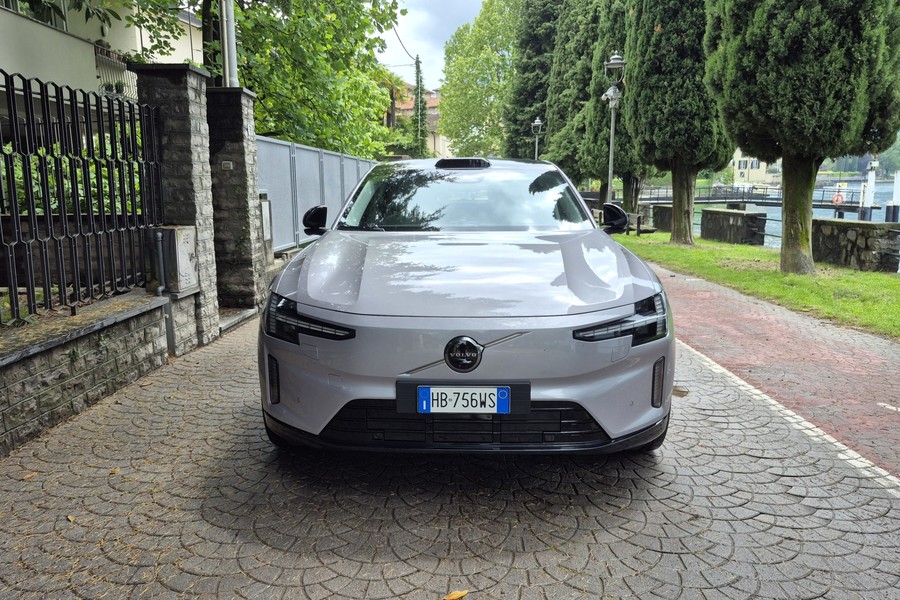
The 2026 Volvo ES90 is simultaneously infuriating and brilliant. Tested in Italy by Driving.ca, Volvo’s new 5.0-metre flagship electric sedan delivers 800-volt ultra-fast charging, a real-world 450 km range, and a ride quality the reviewer called better than a Rolls-Royce. Yet Canadians cannot buy it, blocked first by China EV tariffs, and now tangled in the wider U.S. tariff fight that has already sidelined the EX90.
After a full week in the Alps with the Single Motor Ultra, here is the complete, no-fluff breakdown: what works, what frustrates, exact charging speeds, real efficiency, and why the ES90 could be the most important Volvo EV since the EX90.
Key Takeaways
- Ride first, everything else second: Four-C adaptive air suspension delivers a genuinely Rolls-Royce-level waft, even in Performance mode.
- Real range you can trust: 92 kWh battery, 88 kWh usable. WLTP claims 664 km. Real Alpine testing: 450 km at ~21 kWh/100 km.
- 800V true fast charging: 310 kW peak Single Motor, 350 kW Twin Motor. 10-80% averages 177.3 kW, about 20 minutes 50 seconds.
- Big luxury sedan footprint: 5,000 mm long, 2,410 kg, 1,039 mm front legroom, 899 mm rear, 1,400 mm+ shoulder room both rows.
- Canada problem: Built in China. Import blocked by 100% China EV surtax. Estimated Canadian pricing $85,000-$117,500 CAD if tariffs ease, per Driving.ca analysis.
Why the Volvo ES90 matters right now
Volvo’s EV push has been SUV heavy. The EX90, built in South Carolina, is currently tariff-locked out of Canada at a 25% import penalty. The Volvo EX60 electric SUV, arriving for 2027 with a targeted 400-mile range, will help. But sedans still matter for efficiency.
The ES90 is Volvo’s electric S90 successor, riding on SPA2, with a Polestar-style liftback, a higher seating position than a classic sedan, and true flagship hardware: dual Nvidia Drive AGX Orin computers, roof-mounted lidar, and an 800-volt battery system shared with the EX90.
It is, in Driving.ca senior writer David Booth’s words, “the best EV I have driven since Lucid’s Air,” trading Lucid’s outright thrust for Volvo comfort. If you are cross-shopping luxury electric sedans, see our full breakdown of the Lexus ES 350e electric luxury sedan, which starts at $48,895 and prioritizes refinement over range.
What makes the ES90 frustrating: visibility and digital overload
The ES90’s biggest real-world flaw is rear visibility. At 5,000 mm long, it is very large for European streets. The fastback design, plus a decorative rear header trim, reduces the rear glass to what Booth calls “a mere slit,” comparable to backing up a Lamborghini Countach.
Volvo attempts to compensate with cameras and sensors, but:
- European side mirrors are small and slightly fish-eyed
- The rear camera distorts badly up close, “like a third-year engineering flashback”
- The saving grace is an accurate ultrasonic proximity sensor
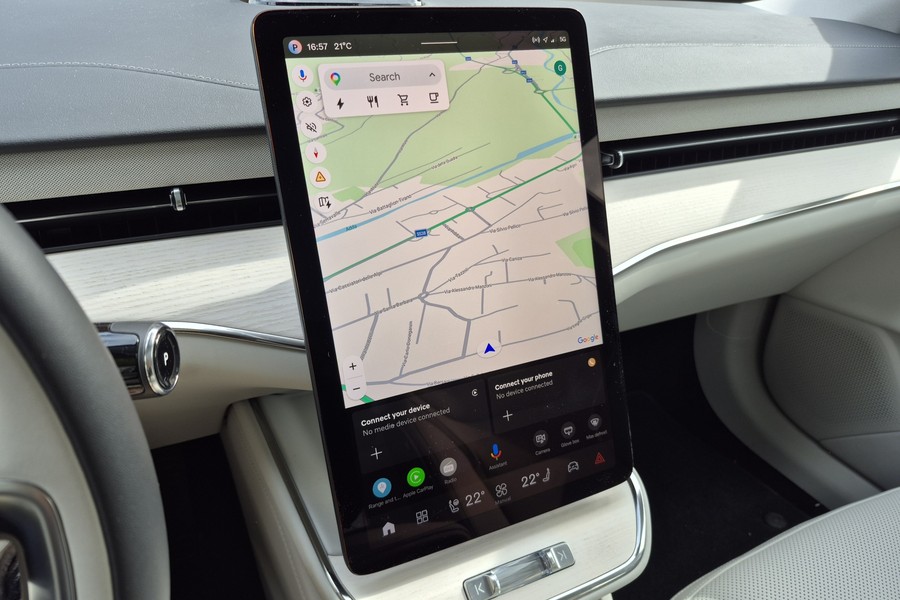
Other digital niggles persist: mirror and steering wheel adjustment are buried in the 14.5-inch touchscreen. Booth reports he sometimes manually moved the seat to avoid sub-menus, a familiar complaint in modern Volvo EVs.

Interior tech: CarPlay redemption and Scandinavian minimalism
Once you survive the menus, the cabin redeems itself. The 14.5-inch portrait Google-built infotainment is one of the most Apple CarPlay-friendly systems tested, connecting instantly, with clear large icons.
Highlights verified in Italy:
- 9.0-inch slim driver display, speed and warnings only
- Trip efficiency app: simple, accurate, detailed
- Charging app: harder to find, excellent once located
- 25-speaker Bowers and Wilkins system on Ultra trim
- Sumptuous leather, convincing synthetics, matte metal trim
- 1,039 mm front legroom, 899 mm rear, 1,400 mm+ shoulder and hip room both rows
The minimalist approach will feel familiar if you have followed Volvo’s recent interiors. For a more screen-first experiment that split opinion, our Xpeng P7 family EV sedan review shows how Chinese rivals handle the same balance, with triple Turing chips and 11.3-minute 10-80% charging.
Ride quality: smoother than a Rolls-Royce?
This is where the ES90 rewrites expectations. Booth: “I think the Volvo rides better than said Rolls-Royces. Yes, I did put that in print.”
Why it works:
- Curb weight 2,410 kg improves sprung-to-unsprung ratio
- Updated Four-C adaptive damping, tuned for compliance
- Low sedan center of gravity versus SUVs, less body heave
- Comfort mode is almost surreal. Performance mode was still magic during testing
It is not a sports sedan. Steering is weighty and accurate, roll is well contained for a 2.4-tonne car, and high-speed stability in Italy was excellent. Think S-Class waft, not Taycan turn-in. If you want outright track performance in an EV, our Cadillac Lyriq-V electric performance SUV review covers 615 hp and a 3.3-second 0-60 mph run, a very different philosophy.

Performance and powertrain: 329 hp Single Motor, 671 hp Twin Motor
| Spec | ES90 Single Motor RWD | ES90 Twin Motor Performance AWD |
|---|---|---|
| Power | 329 hp | 671 hp |
| 0-100 km/h | 6.6 seconds | 4.0 seconds flat |
| Battery total / usable | 92.0 kWh / 88.0 kWh | 106.0 kWh / 102.0 kWh |
| WLTP range | 664 km claimed | ~702 km claimed |
| Real-world tested range | 450 km | ~475 km estimated |
| Peak DC charging | 310 kW | 350 kW |
| Weight | 2,410 kg | not published, heavier |
| Architecture | 800-volt SPA2, Nvidia Drive AGX Orin x2 | |
The tested Single Motor is brisk, not brutal. 6.6 seconds to 100 km/h is confident for passing, calm for families. The Twin Motor Performance doubles output to 671 hp and hits 100 km/h in four seconds flat, satisfying EV thrust expectations.
For context on where luxury EV sedans sit today on power and range, see our updated top electric vehicles of 2025 comparison, with Lucid Air at 516 miles and Tesla Model 3 Performance benchmarks.
Real-world range: 450 km you can actually achieve
WLTP rates the Single Motor at 664 km. Real Alpine driving returned a consistent 450 km estimate on the dash, and 450 km achieved.
Test conditions, per Driving.ca: Milan climb of ~1,000 metres, mixed highways, Bernina Pass at 2,328 m, average consumption about 21 kWh/100 km. No steady 125 km/h autostrada test was possible, so Ontario Highway 407 results may differ, but efficiency was notably strong for a 5-metre, 2.4-tonne car.
The Twin Motor adds a 106 kWh pack, 102 kWh usable, with about 6% more range in Volvo estimates, roughly 475 km real-world by extrapolation.

800-volt charging: how fast is the ES90 really?
All ES90 batteries run 800 volts. Verified numbers, sourced via EVKX.net and cited in the original test:
- Peak: 310 kW Single Motor, 350 kW Twin Motor
- Peak hold: 310 kW only between about 20-21% SoC, very narrow
- 10-80% average: 177.3 kW
- 10-80% time: 20 minutes 50 seconds, beating Volvo’s 22-minute claim
- Sweet spot: 7% to 61% in 11.5 minutes, before a steep drop after 60%
Expert insight: plan two short stops, 7-61%, rather than one long 10-80% session, if you are chasing minimum travel time. All figures require a true 350 kW DC charger.
Safety tech and autonomous hardware
The ES90 launches Volvo’s Safe Space Technology stack:
- 5 radar sensors, 7 cameras, 12 ultrasonic sensors
- Roof-mounted lidar
- Dual Nvidia Drive AGX Orin supercomputers, ~500 trillion operations per second combined
- Interior radar sensitive enough to detect “submillimetre scale movement, like the gentle breathing of a baby,” per Volvo
Full hands-off autonomy timing remains unconfirmed by Volvo, but OTA capability is built in.

Watch: 2026 Volvo ES90 full video review
Video: “The 2026 Volvo ES90 Is the Luxury EV We've Been Waiting For” - YouTube. Embedded for editorial commentary.
Should Canada get the ES90? Price, tariffs, and reality
Right now, no. The ES90 is built in China, hit by Canada’s 100% China EV surtax. The EX90, built in the U.S., is blocked by reciprocal 25% tariffs with no Canadian manufacturing remission.
Pricing context from Driving.ca, July 2026:
- Italy base Single Motor: €73,500
- Straight FX conversion: ~$117,500 CAD
- Volvo Canada historical pricing model estimate: as low as ~$85,000 CAD
At $85,000-$95,000 CAD, the ES90 undercuts a base Lucid Air significantly, while offering S-Class size, 800V charging, and class-leading ride comfort. That makes the tariff blockade especially frustrating for Canadian EV buyers.
Volvo has not confirmed a North American assembly shift. Until tariffs change, the ES90 remains an import-only halo, like several other compelling EVs we have tracked in our hybrid and PHEV coverage, including the Volvo XC60 Recharge plug-in hybrid balanced electrification review.
2026 Volvo ES90 photo gallery


Pros and Cons
Pros
- Rolls-Royce-level ride comfort, even in Performance mode
- Honest 450 km real range, 21 kWh/100 km efficiency
- 800V, 310-350 kW charging, 10-80% in ~21 minutes
- Huge, quiet, beautifully finished Scandinavian cabin
- Class-leading safety hardware: lidar + dual Orin
- Potentially strong value at estimated $85k CAD
Cons
- Terrible rear visibility, distorted backup camera
- Touchscreen-only mirror and steering adjustment
- Single Motor 329 hp feels calm for a $100k EV
- 5.0 metres long, tight in European / urban parking
- Not available in Canada or the U.S. due to tariffs
- Charging curve drops sharply after 60% SoC
FAQ: 2026 Volvo ES90
What is the real-world range of the 2026 Volvo ES90?
Driving.ca achieved a consistent 450 km in mixed Alpine driving with the 92 kWh Single Motor, averaging about 21 kWh/100 km. WLTP claims 664 km, which is optimistic.
How fast does the Volvo ES90 charge?
800-volt architecture. Single Motor peaks at 310 kW, Twin Motor at 350 kW. 10-80% averages 177.3 kW, taking 20 minutes 50 seconds on a 350 kW charger. Best efficiency: 7% to 61% in 11.5 minutes.
Is the Volvo ES90 coming to Canada?
Not currently. The ES90 is built in China and blocked by Canada’s 100% China EV surtax. Volvo Canada has not announced an import plan. The related EX90 is also paused due to U.S. tariffs.
How much will the Volvo ES90 cost in Canada?
Unconfirmed. Italy pricing starts at €73,500. Driving.ca estimates a Canadian MSRP between approximately $85,000 CAD using Volvo’s historical pricing model, and $117,500 CAD at straight currency conversion. Official pricing has not been released.
Volvo ES90 vs EX90: which is better?
Same SPA2 platform and tech core. ES90 is lower, slipperier, more efficient, and rides better, with a liftback trunk. EX90 offers 7 seats and SUV ride height. Booth preferred the ES90 unless you need three rows.
What are the Volvo ES90 horsepower and 0-100 times?
Single Motor RWD: 329 hp, 0-100 km/h in 6.6 seconds. Twin Motor Performance AWD: 671 hp, 0-100 km/h in 4.0 seconds flat.
Is the ES90 bigger than a Tesla Model S?
Yes, slightly longer and taller. ES90 is 5,000 mm long, with a higher roofline and liftback access, and 2,410 kg curb weight. Interior shoulder and hip room exceed 1,400 mm in both rows.
Verdict: comfort king, tariff casualty
The 2026 Volvo ES90 is the most comfortable EV this reviewer has driven short of a Lucid Air, and arguably smoother than a Rolls-Royce Ghost on broken Alpine tarmac. Add honest 450 km range, true 800V 310 kW charging, lidar-level safety, and a restrained Scandinavian cabin, and you have a flagship electric sedan that finally feels like a true S-Class rival, without the S-Class price, if Volvo’s $85k CAD estimate holds.
The flaws are real: dreadful rear visibility, fiddly touchscreen controls, and calm Single Motor acceleration by EV standards. None are deal breakers. Tariffs are.
Until Canada resolves China EV surtaxes and U.S. reciprocal tariffs, the ES90 joins the EX90 on the “best EVs you cannot buy” list. That is a loss for buyers, because sedans like this prove electric luxury does not have to be an SUV.
Would I pick it over a Model S, an EQE, or even the new ES 350e? For ride comfort and charging calm, yes. For outright speed, no. For value, wait for official Canadian pricing, then test it back to back.
Tell us in the comments, and explore more EV first drives on World Cars Blog.
Review analysis based on Driving.ca first drive by David Booth, Italy, June 2026, photography by Nadine Filion. Specifications: Single Motor 329 hp / 92 kWh, Twin Motor 671 hp / 106 kWh, 800V, as tested. Prices and availability subject to tariff changes. Always verify with Volvo Canada before purchase decisions.


